How to Calculate Percentage, Grade and Position on a School Result Card
Step-by-step: total marks, percentage, grade (A+ to F), pass or fail rules and class position for result cards in Pakistani schools — with a worked example.
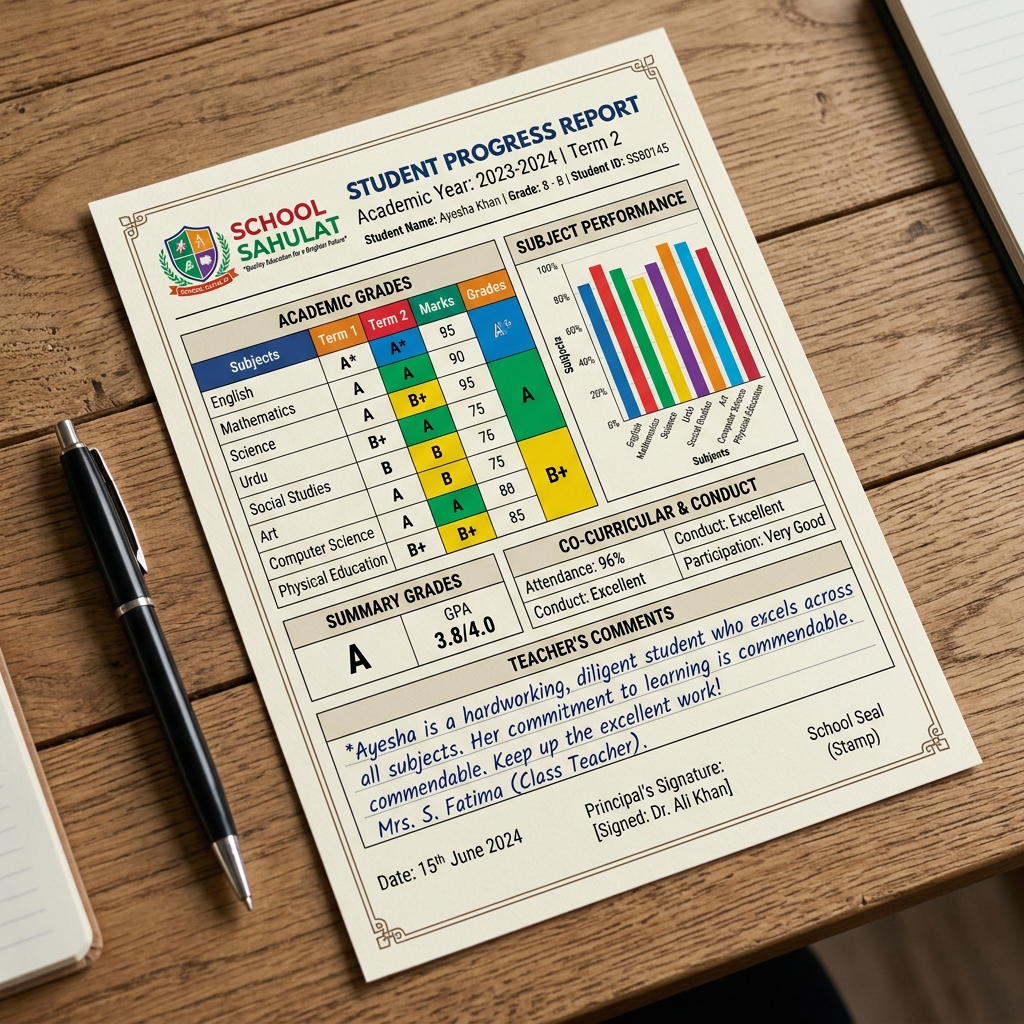
Result cards cause more parent complaints than almost anything else a school prints — usually because of a small calculation mistake, an unclear grading rule, or a position that doesn't match. Here is how to get each number right.
Step 1: Total and obtained marks
Add up the total marks of every subject, then the marks the student obtained. If subjects have different totals (English out of 100, Drawing out of 50), add them as they are — don't convert them first.
| Subject | Total | Obtained |
|---|---|---|
| English | 100 | 82 |
| Urdu | 100 | 75 |
| Mathematics | 100 | 91 |
| Science | 100 | 78 |
| Islamiat | 50 | 44 |
| Drawing | 50 | 42 |
| Total | 500 | 412 |
Step 2: Percentage
Percentage = obtained ÷ total × 100.
For the example: 412 ÷ 500 × 100 = 82.4%.
Round to one or two decimal places and use the same rule on every card. Mixing 82% and 82.4% across students is how disputes start.
Step 3: Grade
Most Pakistani schools use a scale like this:
| Percentage | Grade |
|---|---|
| 80% and above | A+ |
| 70% – 79% | A |
| 60% – 69% | B |
| 50% – 59% | C |
| 40% – 49% | D |
| Below 40% | F |
82.4% is an A+. Whatever scale you use, print it on the result card so parents can check it themselves.
Step 4: Pass or fail
Decide this rule in writing before the exam:
- the student must get at least 40% overall, and
- at least 40% in every subject.
A student with 65% overall but 30% in Urdu has failed Urdu, even though the overall percentage looks fine. Show failed subjects clearly on the card.
Step 5: Position in class
Sort all students in the class by obtained marks (or percentage, if totals differ). The highest is 1st. If two students have the same marks, they share the position, and the next student takes the position after both — two students at 2nd means the next one is 4th, not 3rd.
Many schools only print positions for the top three to avoid discouraging other students. That is a policy choice; be consistent.
Step 6: Attendance and remarks
Add days present out of total days, and one or two lines from the class teacher. Specific remarks help more than general ones: "Strong in Maths, needs to read more Urdu at home" is more useful than "Good".
Common mistakes
- Obtained marks entered higher than the total.
- A subject left out of the grand total.
- Different rounding on different cards.
- Positions worked out before late marks were entered.
Make it once, or for the whole class
To make a single card, use our free result card maker — it does the total, percentage, grade and pass/fail for you, in English or Urdu, with a madrasa style too. For a whole class, School Sahulat takes marks once and prints every card with positions worked out automatically.
- Result card
- Exams
- Grading
Keep reading
 Attendance
Student Attendance That Parents Trust: Marking, Absence Alerts and Monthly Reports
A simple daily attendance routine for Pakistani schools and institutes — how to mark it quickly, when to inform parents of absences, and what a monthly report should show.
2 min read
 Fees
How to Make a School Fee Voucher (Challan) in Pakistan — Format and Example
What a school fee challan must include, why it has three copies, how to work out arrears and late fine, and how to make one free in English or Urdu.
3 min read