How to Track Hifz Progress: Sabaq, Sabqi and Manzil Records for Madaris
A practical way for madaris to record daily Sabaq, Sabqi and Manzil, spot students who are falling behind, and keep parents informed about Hifz progress.
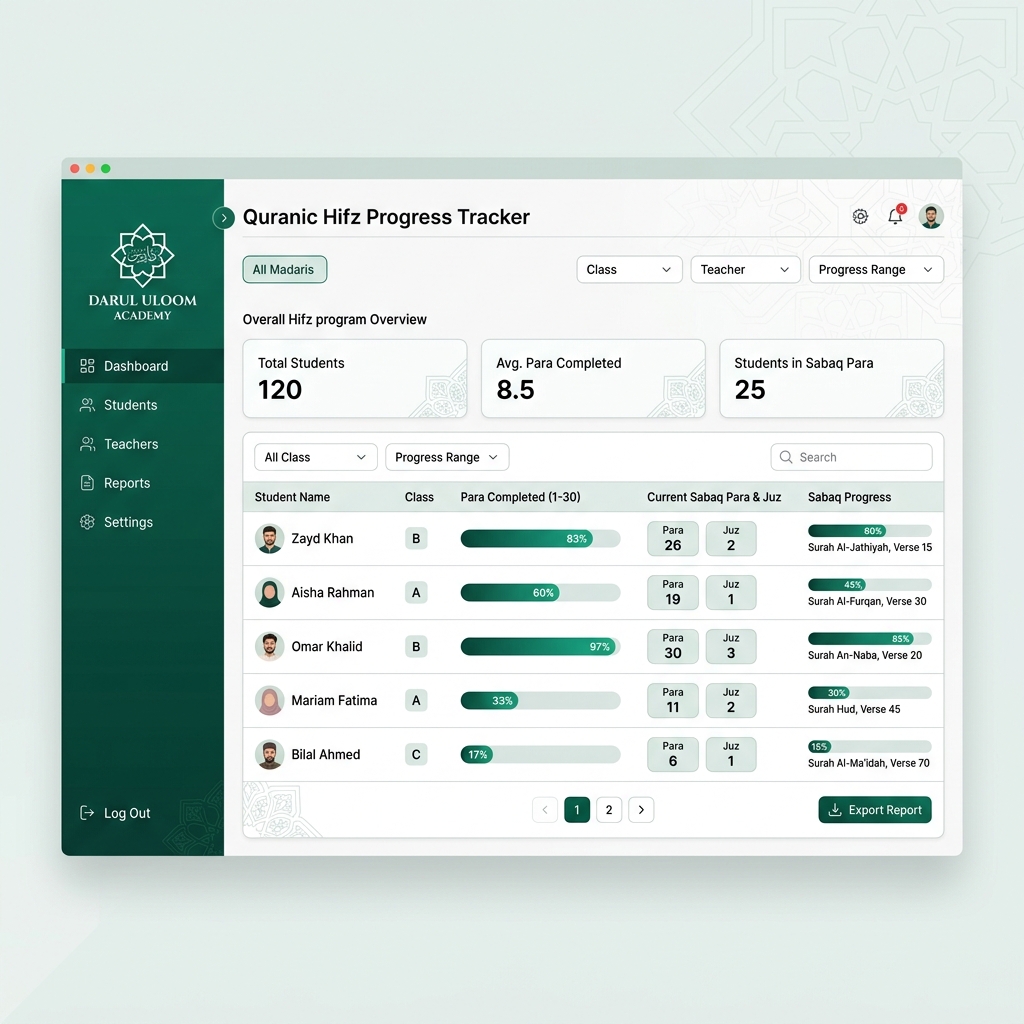
Every Hifz teacher keeps some kind of record — a register, a notebook, sometimes just memory. The problem shows up when a student moves to another teacher, when a parent asks how their child is doing, or when the Mohtamim wants to know which students need attention before the annual test.
The three parts of a daily record
Most madaris track three things every day:
- Sabaq — the new lesson memorised today (para, page or lines).
- Sabqi — the recent portion revised (usually the last few days or the current para).
- Manzil — the older portion revised from what the student has already completed.
For each one, record how much and how well. A simple quality mark works: Mumtaz, Jayyid, Maqbool, or "repeat".
What a good record looks like
| Date | Sabaq | Sabqi | Manzil | Remarks |
|---|---|---|---|---|
| 6 Oct | Para 12, p. 4–5 | Para 12, p. 1–3 | Para 3–4 | Mumtaz |
| 7 Oct | Para 12, p. 6 | Para 12, p. 2–5 | Para 5–6 | Repeat Sabaq |
Two lines like these tell a teacher more than a page of notes: the student is moving through para 12, the revision is on track, and yesterday's new lesson needs another try.
Spotting students who are falling behind
Look for three patterns each week:
- Sabaq repeated on more than two days.
- Manzil skipped or always marked weak — the student is learning new portions but losing old ones.
- Absences in a row, which almost always show up as weak Manzil a week later.
Catching these early, and talking to the student and parents, does far more than a poor result at the end of the term.
Keeping parents involved
Parents want to know two things: how much has been memorised, and whether their child is keeping it. A short weekly message works well — the paras completed, the current para, and one line from the teacher. Parents who hear regularly are more likely to help with revision at home.
Moving from registers to a system
Paper registers work until they get lost, get wet, or move with a teacher who leaves. A digital record keeps the full history of every student — every para, every revision — in one place, and any teacher can pick up where the last one left off.
School Sahulat has a Hifz module built for exactly this: daily Sabaq, Sabqi and Manzil, para-wise history, and progress the parent can see on their phone. For exams, the result card maker has a madrasa style with Hifz, Nazra and Tajweed already added.
- Madrasa
- Hifz
- Record keeping
Keep reading
 Attendance
Student Attendance That Parents Trust: Marking, Absence Alerts and Monthly Reports
A simple daily attendance routine for Pakistani schools and institutes — how to mark it quickly, when to inform parents of absences, and what a monthly report should show.
2 min read
 Fees
How to Make a School Fee Voucher (Challan) in Pakistan — Format and Example
What a school fee challan must include, why it has three copies, how to work out arrears and late fine, and how to make one free in English or Urdu.
3 min read